Your cat sleeps most of the day, then suddenly sprints across the living room at midnight. Maybe she meows at nothing, or knocks your pens off the desk one by one while watching your face. If you live in an apartment, you might worry there is just not enough going on for her. You are right to think about it. Learning how to keep an indoor cat from getting bored is one of the kindest things you can do for a pet who never goes outside.
An indoor cat has a safe life. No cars, no fights, no parasites from the yard. But safe can also mean understimulated. A bored cat finds her own entertainment, and that usually means your furniture, your sleep, or your sanity.
The good news: you do not need a huge home or expensive gadgets. You need a bit of routine and a few smart changes. Here is how to do it.
Why an indoor cat gets bored in the first place
Cats are predators. Even the laziest tabby on your couch is wired to stalk, chase, pounce, and catch. Outdoors, a cat does this dozens of times a day with bugs, leaves, birds, and small prey. Indoors, all of that disappears unless you bring it back.
When a cat has nothing to hunt, the energy does not go away. It builds up. That is where the problems start. Boredom in cats often looks like behavior issues, not sadness. You see overgrooming, scratching, attention-seeking, fights with other pets, or a cat who eats out of pure habit because food is the only fun thing happening.
So the goal is simple. Give that hunting brain something to do every single day.
Ways to keep your indoor cat busy and happy
You do not have to do all of these. Pick a few, build them into your day, and watch what your cat responds to. Every cat is different. Some live for the wand toy, some only care about the window.
Play with her like prey, twice a day
This is the big one. A wand toy with feathers or a string mouse lets your cat chase, pounce, and catch. Move the toy like a real animal would: dart it away from her, hide it behind a chair, let it freeze, then bolt. Two short sessions of ten minutes each beat one long one. End the game with a “catch” so she gets the win, then a small treat. That full cycle of hunt and reward leaves her calm and satisfied.
Feed her brain, not just her bowl
Free-feeding from a bowl is boring. Make her work a little. Food puzzles, treat balls, or a snuffle mat turn a meal into a small hunt. You can also hide a few kibble pieces around a room and let her find them. This taps the same instinct as hunting and slows down fast eaters too. Start easy so she does not give up, then make it harder.
Give her height and a window seat
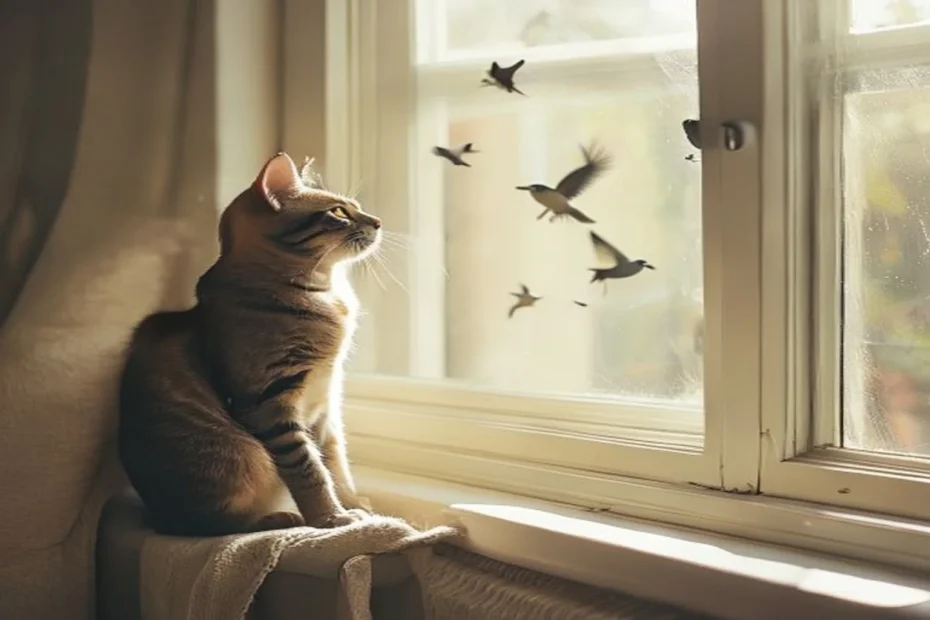
Cats love to climb and watch from above. In a small apartment, go vertical. A cat tree, a tall shelf, or a window perch gives her territory without taking floor space. A window with a view of birds, people, or trees is basically cat television. If you can, set up a bird feeder outside the glass. She can watch it for hours.
Rotate her toys so they feel new
Ten toys out at once become invisible fast. Keep most of them in a box. Put out three or four, then swap them every few days. A toy she ignored last week feels brand new when it comes back. This one trick costs nothing and keeps her interested far longer.
Add a friend, if it fits your home
For some cats, a second cat is the best toy of all. A playmate gives wrestling, chasing, and company while you are at work. This is not right for every cat or every home, and a bad match makes things worse, not better. Think hard before you commit, and introduce them slowly if you decide to try.
Quick answers
How do I know if my cat is bored?
Watch for overgrooming, scratching furniture, knocking things over, midnight zoomies, or constant attention-seeking. A bored cat also tends to sleep even more than usual and eat out of habit.
How much daily play does an indoor cat need?
Aim for two play sessions of about ten to fifteen minutes each. Short and active beats one long session. Consistency matters more than length.
Do automatic toys keep a cat entertained?
They help, but they do not replace you. Cats often lose interest in a toy that moves the same way every time. Use auto-toys as a backup, not your main plan.
Will a second cat fix boredom?
Sometimes. A good match adds play and company. A bad match adds stress and fighting. It depends on your cat’s personality and a slow, careful introduction.
Common mistakes to avoid
- Using your hands as toys. It teaches biting and scratching of people. Always play through a toy.
- Leaving every toy out at once, so nothing feels special anymore.
- Skipping play on busy days. Boredom builds up fast and comes out as bad behavior at night.
- Free-feeding a full bowl all day, which removes the fun and the structure from meals.
- Ignoring sudden changes. If your cat stops playing, hides more, or grooms a bald spot, that can be stress or a health issue. When behavior changes out of nowhere, consult your vet to rule out pain or illness first.
Conclusion
A bored indoor cat is not a lost cause. She just needs a job. Give her real play that mimics hunting, make her food a little bit of work, add height and a window to watch, and keep her toys feeling fresh. Start with one change this week, like two short play sessions a day, and build from there. If your cat’s energy or mood shifts suddenly and the usual tricks do not help, check in with your vet to make sure nothing physical is behind it.
You might also like
- Why Your Cat Stares at You
- How to Create a Calm Hideaway for an Anxious Pet
- Window Perches and Vertical Space Ideas for Apartment Cats
FAQ
Can I leave my cat alone all day?
Most adult cats handle a workday fine if they have food, water, a clean litter box, and things to do. Set up puzzles, a window perch, and rotated toys so she is not staring at empty walls.
Is catnip good for bored cats?
For many cats, yes. It triggers a short burst of play and excitement. Not all cats react to it, and the effect fades fast, so use it as an occasional treat rather than your whole plan.
Why does my cat get wild at night?
Pent-up energy from a quiet day often explodes after dark. A solid play session in the evening, ending with a treat, helps burn that off so you both sleep better.

Jamie Cole is a content creator focused on practical pet care for apartment living. At NestPath, Jamie shares straightforward guides on cat and dog care, pet behavior, and making small spaces work for both owners and their animals. The goal is clear, judgment-free advice for everyday pet owners who just want to do right by their pets.