The Best Cat Trees and Scratching Posts for Small Spaces
In this article
Cats need to climb, scratch, and perch. In a small apartment, the challenge is meeting those needs without a cat tree taking over the room.
The good news: the best solutions for small spaces are also the most effective for the cat’s enrichment.
> 💡 Key idea: Tall and narrow beats short and wide in small apartments. A floor-to-ceiling cat tree in a corner takes no floor space and gives the cat maximum vertical territory.
Quick summary (for busy people)
- ✔️ Floor-to-ceiling units use wall space instead of floor space
- ✔️ Wall-mounted cat shelves are the most space-efficient option
- ✔️ A single tall sisal post beats multiple small ones
- ✔️ Corner placement maximizes stability and minimizes footprint
Why cats need vertical space
Cats feel safer when they can be high up. In an apartment, the furniture becomes their territory map. Without designated high spaces, they use your bookshelves, counters, and refrigerator top instead.
Providing designated climbing spots reduces territorial behavior and stress, especially in multi-cat homes.
Best options for small apartment spaces
1) Floor-to-ceiling tension cat tree
- Why it works: Installs with spring tension between floor and ceiling, no drilling. Takes up as little as 40×40 cm of floor space.
- Best for: Cats who like height. Provides maximum territory without floor footprint.
- What to look for: Weight capacity appropriate for your cat, sturdy base platform, multiple resting spots at different heights.
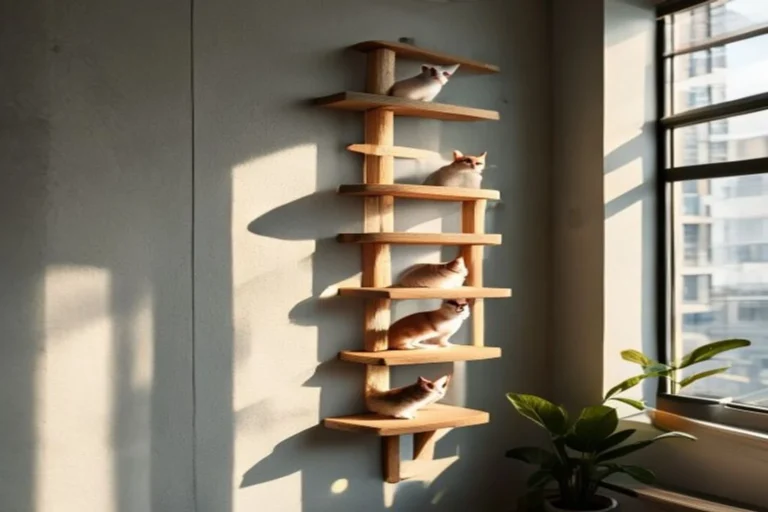
2) Wall-mounted cat shelves
- Why it works: Zero floor footprint. The wall becomes the cat’s climbing route.
- Best for: Owners willing to drill who want a fully custom layout.
- What to look for: Weight capacity per shelf (minimum 10 kg for safety), sisal-covered steps for grip, hammock or perch at the top.
3) Corner cat tree (tall, narrow)
- Why it works: Uses dead corner space with a base footprint of 40-50 cm diameter.
- Best for: Renters who can’t wall-mount and want stability.
- What to look for: At least 150 cm tall, heavy base, sisal-wrapped posts throughout not just at the base.
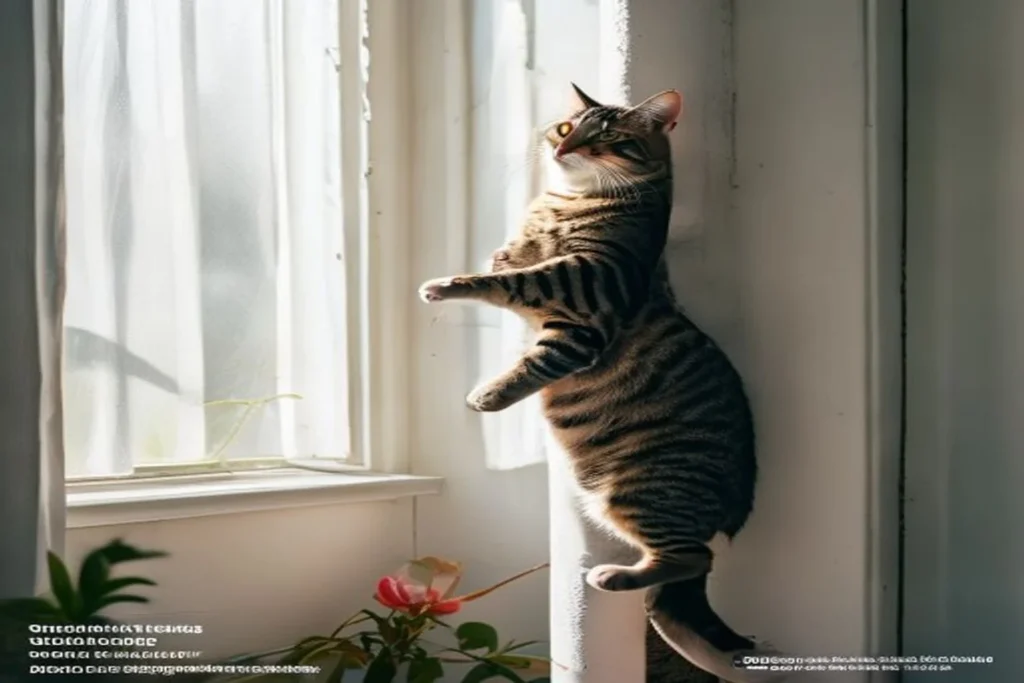
4) Single tall sisal scratching post
- Why it works: Cats need to scratch at full stretch height. A post that reaches 70-80 cm satisfies this without bulk.
- Best for: Apartments where a full cat tree isn’t feasible. Pair with a window perch for vertical territory.
- What to look for: Heavy weighted base, sisal rope (not carpet), tall enough for full body stretch.
5) Window perch
- Why it works: Adds a resting and watching spot without any floor footprint.
- Best for: Cats who love watching outside. Pairs well with any scratching solution.
- What to look for: Weight capacity at least 8 kg, suction cup version for easy installation.
Cat tree and post questions
How tall should a cat tree be?
At minimum, taller than your cat at full stretch: around 90-100 cm. Taller is better. Cats value height proportional to the space available.
Where should I place a cat tree in a small apartment?
Near a window if possible: cats love observing outside. Corner placement maximizes stability. Away from high-traffic areas so the cat has a private retreat.
How do I get my cat to use the cat tree instead of the furniture?
Put the tree near where the cat already likes to be. Sprinkle catnip on the platforms. Reward any use with treats. Make the furniture less appealing temporarily with double-sided tape.
Are wall-mounted cat shelves safe?
Yes, if properly installed into studs or with appropriate wall anchors. Most systems are rated for 15-20 kg per shelf when properly mounted.
How many scratching posts does a cat need?
At least two per cat: one vertical and one horizontal. In a small apartment, one tall vertical post paired with a flat cardboard scratcher covers both preferences.
Run through this
- ☐ Cat tree is taller than cat at full stretch
- ☐ Placed near a window or in a corner
- ☐ Sisal scratching surface available (not just carpet)
- ☐ Cat has introduced to the tree with positive reinforcement
The usual missteps
- Too-short tree: cats lose interest if they can’t get truly high.
- Carpet-covered posts only: cats prefer sisal for scratching.
- Placing the tree in an isolated corner the cat never visits naturally.
Pro tip
If your cat ignores a new cat tree, rub it with the cat’s own scent (use a cloth to transfer scent from their cheeks or paws). This marks it as familiar territory and dramatically increases adoption.
Height and stability, in that order
A small apartment doesn’t mean limited cat territory. Vertical space is the solution. A floor-to-ceiling tree, wall shelves, or even a tall post with a window perch gives your cat the high ground it needs without sacrificing your floor space.