How to Play With Your Cat Every Day Without Any Props
In this article
How to Play With Your Cat Every Day Without Any Props
Interactive play is one of the most important things you can do for your cat’s wellbeing in an apartment. It reduces stress, prevents destructive behavior, and strengthens the bond between you. But you don’t need expensive toys to do it well. Some of the most engaging cat play sessions happen with nothing more than a piece of string or your own hands, used correctly.
The key is mimicking prey behavior, not just waving something randomly.
How Cats Like to Play
Cats are hunters. Their play instinct follows a hunt sequence: stalk, chase, pounce, catch, kill-bite, and groom/rest. Play that includes elements of this sequence is genuinely satisfying. Play that’s just random movement is less engaging.
What this means in practice: let the cat stalk. Move the “prey” slowly, with pauses. Let the cat anticipate and watch before the chase starts. The anticipation is part of the experience.
Play Options That Work Without Props
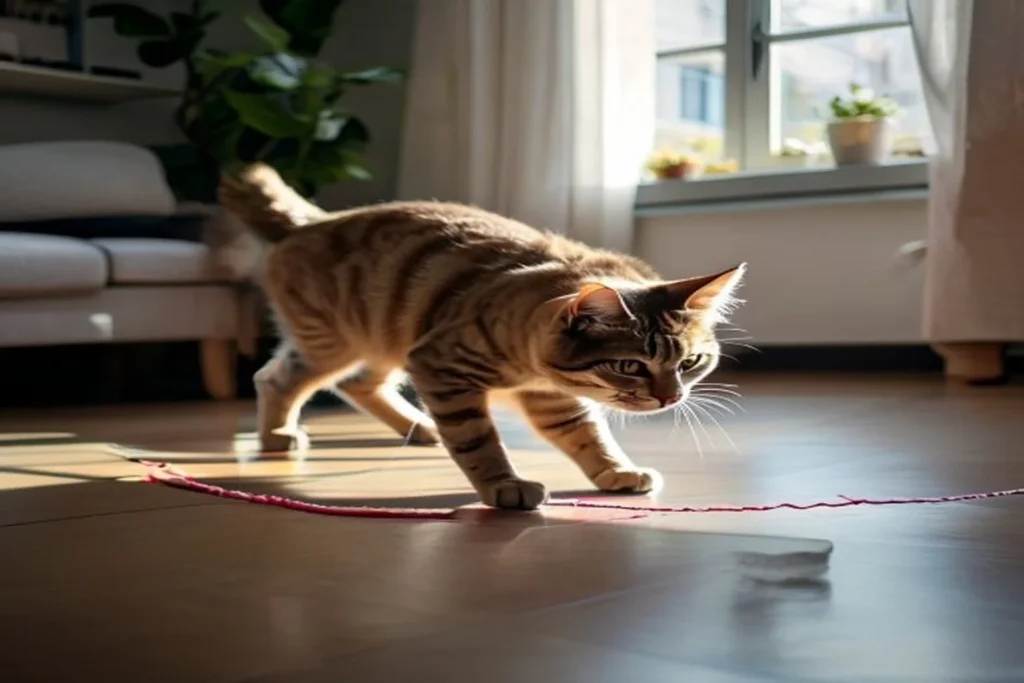
String or shoelace on the floor
- Trail it slowly across the floor, under a blanket, around a corner. Let the cat lose sight of it briefly and then reappear from unexpected angles. The disappearing-and-reappearing movement mimics hiding prey.
- Flick it in short bursts rather than constant motion. Constant motion is less interesting than unpredictable movement.
- Never leave string where the cat can access it unsupervised. Ingested string is a veterinary emergency.
Paper balls
- Crumple paper into a ball and flick it across the floor. Many cats will chase and bat paper balls with as much enthusiasm as any store-bought toy. The crinkling sound adds to the appeal.
- Roll it under the sofa so the cat has to fish it out. This adds the “hidden prey in a crevice” element that drives cats nuts in a good way.
Hands and fingers: with rules
- Playing with your hands directly teaches cats that hands are appropriate targets for biting and scratching. It’s fine when they’re kittens and the bites don’t hurt; it’s a problem when they’re adults.
- If you use your hands, wear a thick glove or use a long sleeve to create distance. Wiggling fingers under a blanket is safer than bare skin: the cat attacks the moving bump, not your hand directly.
Blinking and slow eye contact
- Not exactly play in the energetic sense, but slow blinking at a relaxed cat is one of the clearest forms of communication you can have with them. It reads as “I’m calm, you’re safe, I trust you.” Cats often slow-blink back, which is a trust signal.
Hide and seek
- Move to a different room, peek out from behind a doorway, and retreat. Many cats will follow, peek back, and approach. It activates their curiosity and tracking behavior without needing any object.
- This is particularly effective with shy or newly-adopted cats who aren’t yet comfortable with direct approaches.
When to Play and For How Long
Two sessions per day is the effective minimum for most adult cats. Each session should run 10-15 minutes of actual active engagement. More is fine, but 10-15 minutes twice daily, consistently, produces measurable behavioral improvement over doing nothing.
The best timing: one session in the morning (before you leave) and one in the evening (before their last meal). The evening session, followed by dinner, uses the hunt-eat-sleep natural sequence to help cats settle for the night.
Signs the Play Session Was Good
- The cat is breathing slightly faster, pupils slightly dilated at the end
- They start grooming themselves after the session (winding down)
- They lose interest and walk away on their own: that’s the natural hunt cycle completing
Ending on a “catch” (letting the cat grab and hold the string or paper ball before you put it away) gives the hunt sequence a satisfying conclusion.
Play questions without buying anything
How do I know if my cat is actually enjoying play or just tolerating it?
An engaged cat has dilated pupils, twitching tail tip, flat ears or slightly sideways, crouched body. A bored or stressed cat will be half-heartedly swatting or walking away. If they’re not engaging, change the speed, direction, or take a break. Not every session works equally well.
My cat never seems interested in play. Is that normal?
Some cats have genuinely lower prey drive. Some cats require more patience in finding what type of movement they respond to. Try different things: slow ground-level movement, overhead movement, something that disappears and reappears. Senior cats often have less play drive but usually respond to something. If a previously-playful cat suddenly stops responding to play, a vet check is warranted to rule out pain or illness.
Can I play too much with a cat?
In practice, very rarely. Most cats self-regulate: when they’re done, they stop engaging or walk away. The more common problem is too little play, not too much. The exception is rough play that encourages biting and scratching, which should always be redirected to an appropriate object.
Should I play with my cat before or after feeding?
After play is the natural sequence. Hunt, then eat, then groom, then sleep. This mirrors what cats do naturally and is particularly useful for evening play: ending with dinner and then calm helps cats settle for the night. Morning play before their breakfast works the same way.
Run through this
- ☐ Schedule two 10-15 minute play sessions daily
- ☐ Mimic prey movement: slow stalk phase, then quick burst, then pause
- ☐ End sessions with a “catch” and then feed the cat
- ☐ Never leave string or ribbon accessible unsupervised
- ☐ Try different types of movement if the cat isn’t engaging
The usual missteps
- Moving the toy too fast and constantly without pauses: constant motion is less engaging than unpredictable movement.
- Playing with bare hands or feet, which teaches the cat those are valid prey targets.
- Ending sessions abruptly without a “catch”: the unresolved hunt drive can lead to zoomies or redirected aggression.
The schedule beats the toy
Daily cat play doesn’t require purchasing anything. A shoelace, a paper ball, or even just your presence and attention (used with an understanding of how cats hunt) is enough to provide meaningful engagement. The schedule matters more than the equipment. Two consistent sessions per day, every day, produces happier cats than elaborate toys used sporadically.