The Best Dog Toys for Apartment Living That Won’t Annoy Neighbors
In this article
Toys in an apartment aren’t just about keeping your dog entertained. They need to work within real constraints: not too loud, not too destructive, small enough for indoor use, and durable enough to not need replacing every week. The wrong toy creates noise complaints or leaves your apartment looking like a tornado passed through it.
Here’s what actually works in small spaces.
Categories of Toys That Work Well Indoors
1) Puzzle feeders and food-dispensing toys
- Why they work: These make mealtime or snack time into a mental workout. A dog working to extract kibble from a puzzle feeder is a mentally tired dog, and mental fatigue is as effective as physical exercise for reducing problem behavior.
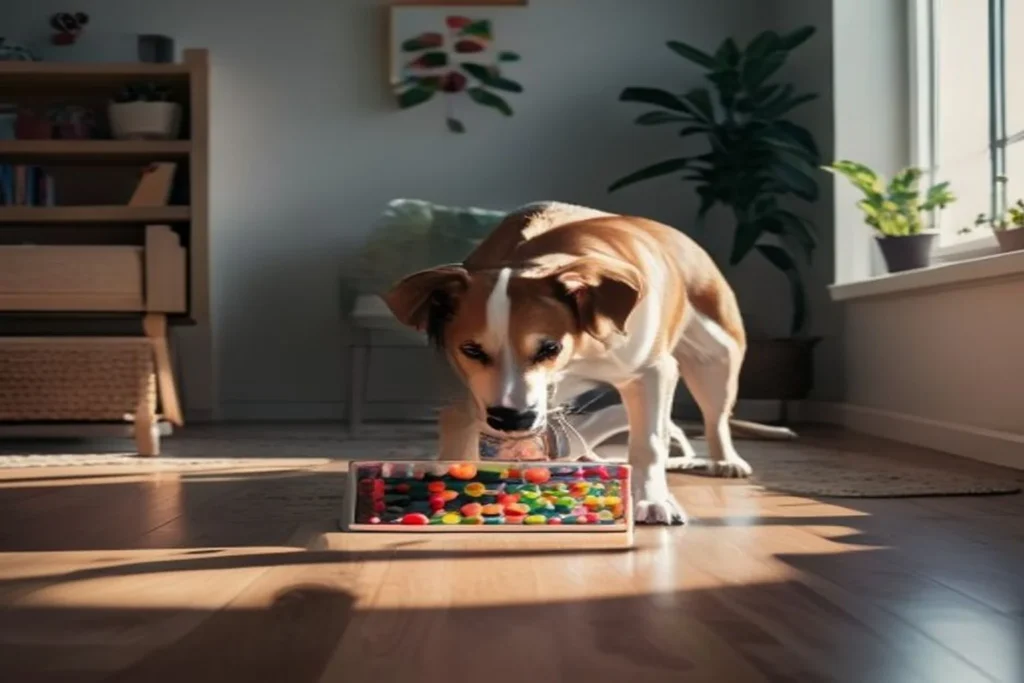
- Good options: Kong stuffed with peanut butter or kibble (frozen overnight for longer-lasting challenge), snuffle mats for nose work, Lickimats for wet food or yogurt, multi-level puzzle toys. These are quiet, can’t be heard through walls, and keep dogs occupied for 20-40 minutes.
- Common mistake: Using them only occasionally. Daily use makes them most effective as part of the dog’s routine.
2) Rope toys and soft tug toys
- Why they work: Good for interactive play without generating noise. You hold one end, the dog pulls. Satisfies the drive to use mouth and body strength in a controlled way.
- Good options: Braided rope toys, rubber ring tugs, fleece braids. The quietest option, no squeaking, no ball bouncing.
- Common mistake: Leaving rope toys out when unsupervised. Rope toys can unravel and the fibers can cause intestinal blockages if ingested.
3) Silent squeaky toys (with variable squeaking)
- Why they work: Squeaky toys satisfy predatory instinct and keep dogs engaged. The issue in apartments is the squeaking being audible through walls.
- Good options: Toys with squeakers that require more pressure to activate (slower squeak), or plush toys with crinkle material instead of squeakers. Avoid high-pitched, rapidly-activating squeakers.
- Common mistake: Giving squeaky toys in the evening. Even relatively quiet squeaking can bother neighbors when it’s late and walls are thin.
4) Chew toys for controlled gnawing
- Why they work: Chewing is a natural stress-relief mechanism for dogs. Appropriate chew toys redirect that to something that doesn’t ruin your furniture.
- Good options: Bully sticks, antlers, dental chews, Nylabones for power chewers. These keep dogs quiet and occupied for extended periods.
- Common mistake: Leaving chews unmonitored. Even appropriate chews can splinter or become small enough to swallow. Supervise until you know how your dog handles them.
5) Scatter feeding and sniff games
- Why they work: Sniffing is more mentally tiring than most physical exercise. Scattering kibble across a room or in a snuffle mat activates the dog’s nose and occupies them completely without any noise.
- How to do it: Take 20-30 pieces of kibble or small treats and scatter them across the floor, under furniture edges, behind cushions. The dog sniffs them out. Five minutes of this equals 20 minutes of walking for mental fatigue.
- Common mistake: Only doing this as a treat activity. This works great as a portion of the dog’s regular meal.
Toys to Avoid in Apartments
- Balls that bounce hard on hardwood floors: every bounce can be heard below
- Highly-pitched, constant squeakers: audible through walls
- Toys that require running for fetch: impossible to use safely indoors
- Electronic toys with loud sounds or music
Toy questions for shared walls
How many toys does an apartment dog need?
Less than you think. 3-5 toys in rotation work better than 20 toys all at once. Rotate every 3-5 days: returning a toy after a brief absence makes it “new” again. Too many choices at once leads to disinterest in all of them.
My dog destroys every soft toy within minutes. What should I try?
Go for tougher materials: reinforced nylon toys, rubber chew toys, or hard plastic puzzle feeders. “Indestructible” soft toys exist but the marketing exceeds the reality for most power chewers. For a dog that loves destroying things, a Kong stuffed with frozen peanut butter is often the most satisfying and durable option.
Can I make DIY toys that work as well as bought ones?
For nose work and enrichment, yes absolutely. Muffin tins with kibble covered by tennis balls, cardboard boxes with treats hidden inside, rolled towels with food inside: all effective. For chewing and durability, commercial toys hold up better.
Do dog toys help with separation anxiety?
Yes, the right ones. A Kong stuffed and frozen before you leave gives the dog something to do during the hardest part of alone time (the first 20-30 minutes). Puzzle feeders and snuffle mats do the same. They won’t cure clinical separation anxiety on their own, but they’re a significant piece of the management puzzle.
Practical checklist
- ☐ Get a Kong and start using it stuffed and frozen daily
- ☐ Add a snuffle mat or puzzle feeder to replace one regular meal per day
- ☐ Rotate 3-5 toys every few days to maintain novelty
- ☐ Avoid high-bounce balls and loud squeakers in the apartment
- ☐ Supervise all chew sessions until you know your dog’s chewing style
Where people go wrong
- Too many toys available at once, which leads to disinterest in all of them.
- Using toys that create noise that travels through walls and floors.
- Not using food-dispensing toys, which are the single best indoor enrichment tool.
Quiet toys, real engagement
The best apartment dog toys are mentally engaging, quiet, and durable. A rotation of a food-dispensing toy, a tug toy for interactive play, an appropriate chew, and a snuffle mat covers every enrichment category without generating noise complaints. Start with the Kong and a snuffle mat and build from there.