How to Groom Your Cat at Home Without the Stress
In this article
Most cats never need a professional groomer. With the right tools and a gradual approach, home grooming becomes a routine the cat tolerates, and some actually come looking for it.
The trick is building the association slowly instead of starting with a full session before the cat is ready. Short, positive sessions build tolerance over weeks. A cat that sits still for a brush does so because the brush has always been followed by something good.
Basic cat grooming at home
1) Brushing
Brushing pulls out loose undercoat before the cat swallows it and brings it back up as a hairball, and before it settles into the sofa. On long-haired cats it also stops mats forming behind the ears, in the armpits and along the back legs, where the fur rubs and tangles.
Brush in the direction the fur grows. Start at the head, which most cats enjoy, and work back toward the tail. Stop before the cat gets irritated, not after. Brushing against the grain or dragging the brush through a tangle hurts, and the cat remembers.
2) Building positive association
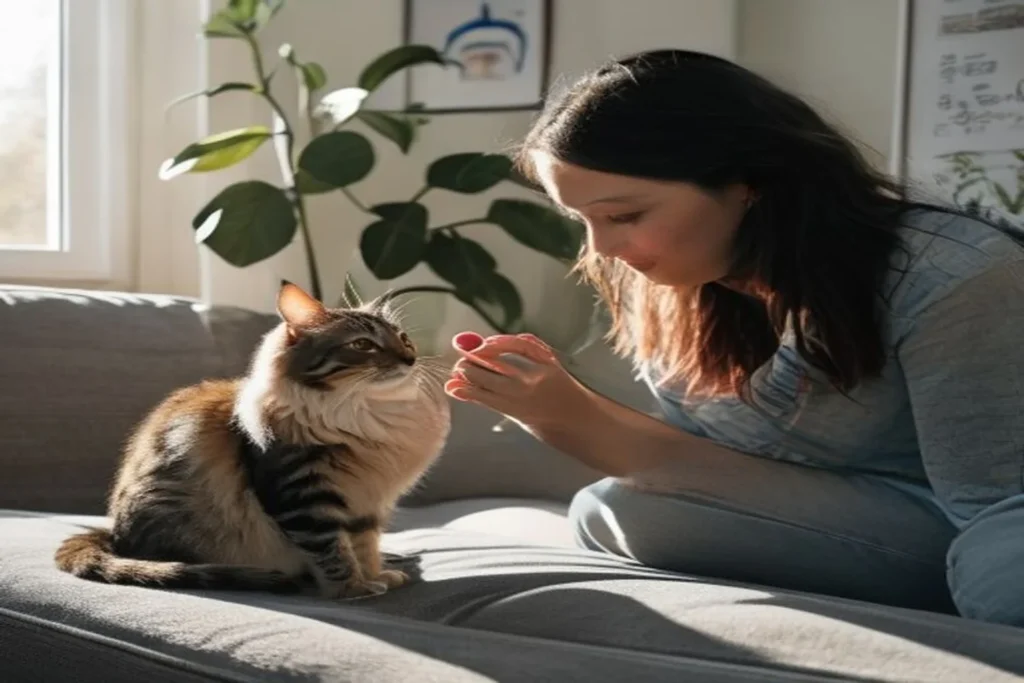
A cat that’s been held down and brushed against its will learns to leave the room when it sees the brush. Start smaller than feels useful: touch the brush to the cat’s shoulder, give a treat, put the brush away. Repeat over several days. Then one stroke with a treat. Full sessions come weeks later.
3) Nail trimming
Overgrown nails snag on blankets and upholstery, and on older cats they can curve all the way around and grow back into the paw pad. Check every four to six weeks.
Hold the paw and press gently on the pad to extend the nail. Cut only the clear curved tip and stay well clear of the pink quick, the blood vessel visible inside the nail. Cutting into it bleeds and hurts, and one bad trim can cost you months of tolerance. Cat clippers or ordinary human nail clippers both work. If the cat is new to this, do one nail and stop.
4) Ear cleaning (when needed)
Some cats build up wax; plenty go their whole lives without needing their ears touched. Clean only when you can see dark debris. Put a vet-approved ear cleaner on a cotton pad and wipe the visible outer folds. Never push anything into the canal: a cotton swab packs wax down against the eardrum instead of removing it.
5) Eye cleaning
Flat-faced breeds like Persians and Himalayans have tear ducts that drain poorly, so discharge crusts in the inner corners. Wipe with a damp cotton pad, from the inner corner outward. Use a fresh pad for the second eye so you don’t carry an infection across.
Home grooming questions
Do short-haired cats need brushing?
Less often than long-haired cats, but yes. A weekly brush cuts down on shedding and hairballs, and many short-haired cats treat it as attention rather than maintenance.
What do I do if my cat has a mat?
Small mats come apart with a mat splitter or a steel comb worked slowly from the outer edge inward. Large mats, or anything tight against the skin, go to a groomer or vet. Never cut a mat off with scissors: mats pull the skin up into themselves, and cat skin is thin enough that you can slice it without realizing.
Does my indoor cat need baths?
Almost never. Cats groom themselves, and a bath is genuinely frightening for most of them. Save it for when they’ve rolled in something sticky or toxic that they shouldn’t lick off.
What’s the best brush for cat grooming?
A slicker brush for loose hair and light tangles. A rubber grooming glove for cats who hate the feel of bristles, since it reads as petting. A steel comb for working through a long coat section by section.
My cat bites during grooming. What do I do?
Stop right there, end the session calmly rather than with a treat, and next time cut it back to whatever the cat handled without reacting. Build up from there. The bite is information: the session went past what the cat could take, usually several strokes earlier, through tail flicks and skin twitches you missed.
When to groom
Right after a play session is the best window. A cat that’s just chased a wand toy around the room is calm and slightly tired, and far more willing to be handled than one that’s been sleeping and wants to go hunt something.
Short sessions, built over weeks
Almost any cat can be groomed at home. What decides it isn’t the cat’s temperament, it’s whether you stop early enough that the cat never learns to dread it.